
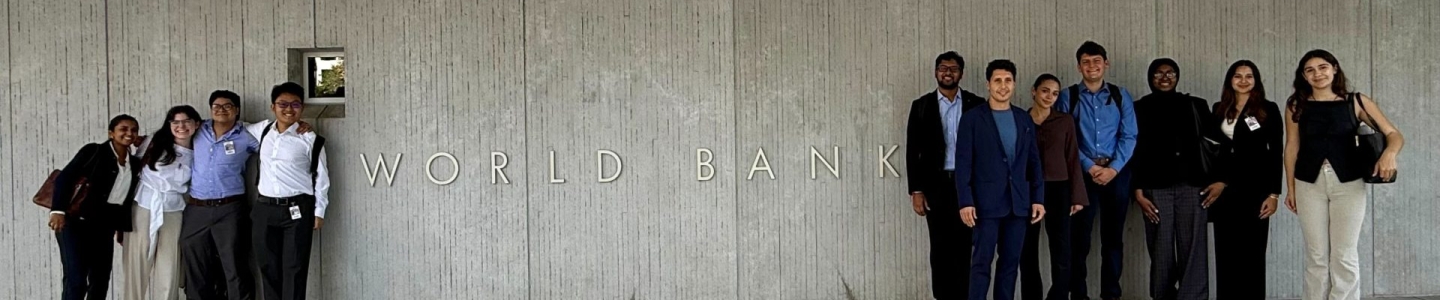
World Bank — Summer Fellowship 2025
Overview
As part of the 2025 Summer Fellowship, PDRI–DevLab fellows partnered with the World Bank to explore how land governance and administration shape the feasibility of climate pledges, the delivery of infrastructure projects, and the fiscal capacity of governments.
Over the course of ten weeks, students worked with World Bank counterparts on four applied research tracks. Their findings were presented to World Bank technical representatives at the institution’s headquarters in Washington, DC, on September 5, 2025.
Project 1 — Land Gap Analysis (Latin America & Caribbean)
Team: Nikita Sadov · Felicia Merino-Östlund · Jackson Owen · Ashti Tiwari (PORES) · Nikhil Pochana · Fernanda Quintanilla
-
Objective: Extend the Land Gap methodology to quantify which climate pledges (NDCs) depend on land, estimate their footprints, and assess enabling governance conditions.
-
Methods: Parsed national climate commitments; identified forestry, agriculture, and energy as dominant land-demand sectors; mapped tenure security, land administration, and consultation as key feasibility conditions.
-
Key Insight: Many pledges are highly land-intensive but do not adequately address governance or tenure — raising questions about feasibility and equity.
-
Next Steps (AY 2025/26): Deepen analysis of the Amazon Basin; produce regional profiles; engage with World Bank teams on policy implications.
Project 2 — Restructuring in Infrastructure Operations
Team: Doer He · Sonya Colattur (PORES) · Talyah Pierce
-
Objective: Quantify how land acquisition/access bottlenecks drive restructuring of World Bank-financed infrastructure (delays, cost overruns, scope changes).
-
Methods: Applied text analytics to restructuring papers; produced project- and portfolio-level statistics (delays in months, cost changes, affected targets).
-
Key Insight: Land challenges are a major driver of restructuring risk, especially in transport and energy sectors.
-
Next Steps (AY 2025/26): Expand sectoral comparisons; refine metrics with World Bank task teams; develop a restructuring dashboard.
Project 3 — Costs of Land Records
Team: Talyah Pierce (+ 2025/26 cohort)
-
Objective: Create a transparent cost taxonomy and benchmarks for producing and maintaining land/property records.
-
Work to Date: Structured typology covering surveying, IT systems, staffing, dispute resolution, and maintenance; compiled preliminary cost ranges.
-
Why It Matters: Provides governments and donors with realistic cost baselines for financing sustainable land administration.
-
Next Steps: Finalize benchmarks, validate through interviews, and prepare a working paper.
Project 4 — Revenue Potential from Land Administration Systems
Team: 2025/26 cohort (ongoing)
-
Objective: Test whether stronger land administration correlates with higher property tax revenues and broader fiscal resilience.
-
Planned Analysis: Cross-country panel on land system strength and revenue performance; explore mechanisms such as cadastre coverage and compliance.
-
Policy Relevance: If fiscal gains are measurable, they can offset reform costs and strengthen the case for land system investments.
Outputs in Progress
-
LAC Land Gap analytics brief with Amazon deep dives.
-
Infrastructure restructuring dashboard and methods note.
-
Cost benchmarking paper on land/property records.
-
Revenue analysis note on land system reforms.